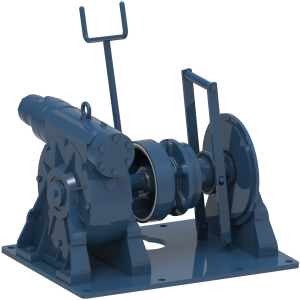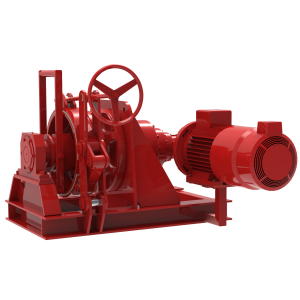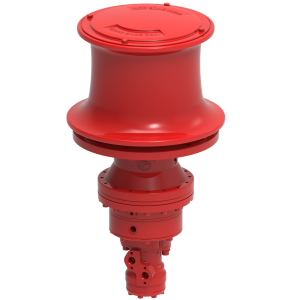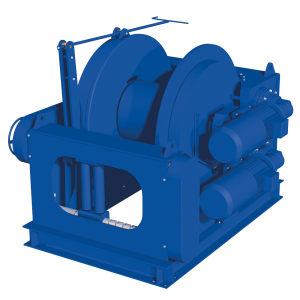
Subsea and ROV winches: lifting below the surface
In short
- Subsea and ROV winches work where the vessel heaves, the water is deep and the sea is corrosive, conditions an ordinary winch never meets.
- Heave compensation stops the load snatching as the deck rises and falls, the pull must carry the umbilical weight as well as the load at full depth, and every surface must resist seawater.
- Lifting at sea is regulated, so these winches are built and certified to class society rules with full traceability, not improvised from a standard machine.
Most winches live and work in air, on a deck, a floor or a structure, with the load in plain sight. Subsea and ROV winches live in a harder world, lowering remotely operated vehicles, instruments and equipment through the waves and down into deep water, sometimes thousands of metres below the surface. Everything about that environment, the motion of the vessel, the depth, the weight of the cable and the corrosive sea, asks more of the winch than dry land ever does. These are not standard machines fitted with a longer rope; they are designed from the start for the deep, and understanding why is the key to specifying one properly.
Why subsea is a world apart
Take a winch that performs faultlessly on a quay and put it to work over the side of a vessel in a seaway and several new forces appear at once. The vessel heaves up and down on the swell, so the load on the rope is no longer steady but surges. The water is deep, so the cable itself becomes heavy and adds to what the winch must hold. The sea is salt, attacking unprotected steel within days. And the work is offshore lifting, which is regulated and certified rather than left to judgement. A subsea winch has to answer all of these together, and each one shapes the design.
Heave: the moving deck
The single greatest difference offshore is heave. As the vessel rises and falls on the swell, a load hanging on the rope is alternately lifted and dropped, and without something to absorb that motion the rope snatches, shock loading the winch, the cable and whatever is on the end. Subsea winches answer this with heave compensation, either passive systems that cushion the motion or active heave compensation that drives the winch to pay out and haul in precisely against the vessel's movement, keeping the load steady relative to the seabed. This is what lets a sensitive instrument be landed gently on the bottom from a deck that is moving metres up and down, and it is central to serious subsea work.
| Challenge subsea | Why it matters | How the winch answers |
| Heave of the vessel | Load snatches as the deck rises and falls | Heave compensation, soft payout |
| Depth and umbilical weight | Cable weight adds to the load | Pull rated for full depth |
| Seawater corrosion | Salt attacks steel fast | Marine coatings, stainless, sealing |
| Certification | Lifting at sea is regulated | Class society approval, traceability |
Depth and the weight of the umbilical
On land the winch lifts the load and little else. Deep in the water it lifts the load plus the entire weight of the cable or umbilical hanging beneath it, and at great depth that cable weight can rival or exceed the payload. A subsea winch therefore has to be rated not just for the equipment on the end but for the full suspended weight of the rope or umbilical at maximum depth, with margin. The drum must also hold that great length of cable, and where the umbilical carries power and signal to an ROV, the winch needs a slip ring so it can turn while the conductors stay connected. Depth changes the sums in ways a surface winch never has to consider.
Standing up to seawater
Salt water is relentless, and a winch that lives in spray and is dunked through the waves will corrode quickly unless it is built to resist. Subsea and splash zone winches use heavy marine coatings, stainless steels for the parts most exposed, sealed bearings and motors, and careful attention to where water can sit and start corrosion, in line with marine protection practice such as ISO 12944 for the splash and immersion zones. Materials that would last for years in a factory fail in months at sea, so the right alloys, coatings and sealing are not a finishing touch but a condition of the winch working at all. Corrosion protection is engineered in, not painted on at the end.
Certified for lifting at sea
Lifting over the side of a vessel is serious, regulated work, and the winch has to prove it belongs there. Offshore lifting equipment is built and certified to the rules of class societies such as DNV, ABS, Lloyd's Register or Bureau Veritas, with documented design, materials traceability and testing, and where people could be involved the higher safety factors that personnel handling demands. This is a world away from buying a winch off a shelf: the certification is part of the product, and a subsea winch without the right approvals is not fit for the job no matter how strong it is. The paperwork is not bureaucracy; it is the evidence that the winch is safe to trust over deep water.
Building it as one engineered system
What makes a subsea winch work is that all of this is designed together rather than bolted on. The heave compensation, the depth rating, the corrosion protection, the slip ring, the drum capacity and the certification are specified as a single system around the actual task, the vehicle or load, the water depth, the sea state and the vessel. Change the depth or the ROV and the sums change with it. This is why serious subsea winches are engineered for the project, and why the honest first step is always to describe the deployment in full, the load, the depth, the umbilical and the conditions, before a machine is proposed. We approach this work as an engineered system, not a catalogue pick.
The hardest moment: the splash zone
If there is one place a subsea deployment is most at risk it is the splash zone, the band of water at the surface where the waves break and the load passes from air into the sea or back again. Above the water the load hangs steady in air; below it the water damps the motion; but right at the surface the load is half in and half out, slammed by passing waves and snatched by the heave, and this is where shock loads peak and where a vehicle or instrument is most likely to be damaged. A well found subsea winch is judged largely on how it handles this moment, paying out or hauling quickly and smoothly through the splash zone so the load spends as little time as possible in that violent band, with the heave compensation working hardest exactly there. Getting a delicate ROV cleanly through the surface in a seaway is the real test of the winch, the control and the operator together, and it is why launch and recovery through the splash zone is planned as carefully as the lift itself. A machine that lowers beautifully in deep water but mishandles the surface has failed at the part that matters most.
Specifying a subsea or ROV winch
Our hydraulic and offshore winch experience covers the demands of work below the surface, from heave handling to corrosion protection and class certification. See the wider range in our winch catalogue, read our overview of hydraulic winches and how drum and rope capacity is set for the great cable lengths the deep demands. Tell us the vehicle or load, the water depth, the umbilical, the vessel and the sea state, and we engineer a winch for the deployment rather than stretching a surface machine to a job it was never built for.
Frequently asked questions
What is a subsea winch?
A subsea winch lowers and recovers equipment, instruments or ROVs through the waves and down into deep water. It is designed for heave, depth, umbilical weight and seawater corrosion, conditions a standard winch is not built for, and is certified for offshore lifting.
What is heave compensation?
Heave compensation stops the load snatching as the vessel rises and falls on the swell. Passive systems cushion the motion; active heave compensation drives the winch to pay out and haul in against the vessel's movement, keeping the load steady relative to the seabed.
Why does umbilical weight matter?
At depth the winch lifts the load plus the full weight of the cable or umbilical hanging beneath it, which at great depth can rival or exceed the payload. The winch must be rated for the whole suspended weight at maximum depth, and the drum must hold that length of cable.
Do subsea winches need certification?
Yes. Offshore lifting is regulated, so subsea winches are built and certified to class society rules such as DNV, ABS, Lloyd's or Bureau Veritas, with documented design, materials traceability and testing. The certification is part of the product, not optional paperwork.